Healthy BodyBody Mass Index Calculator: How to Check Your BMI and What the Result Means
Body Mass Index Calculator: How to Check Your BMI and What the Result Means
The short answer
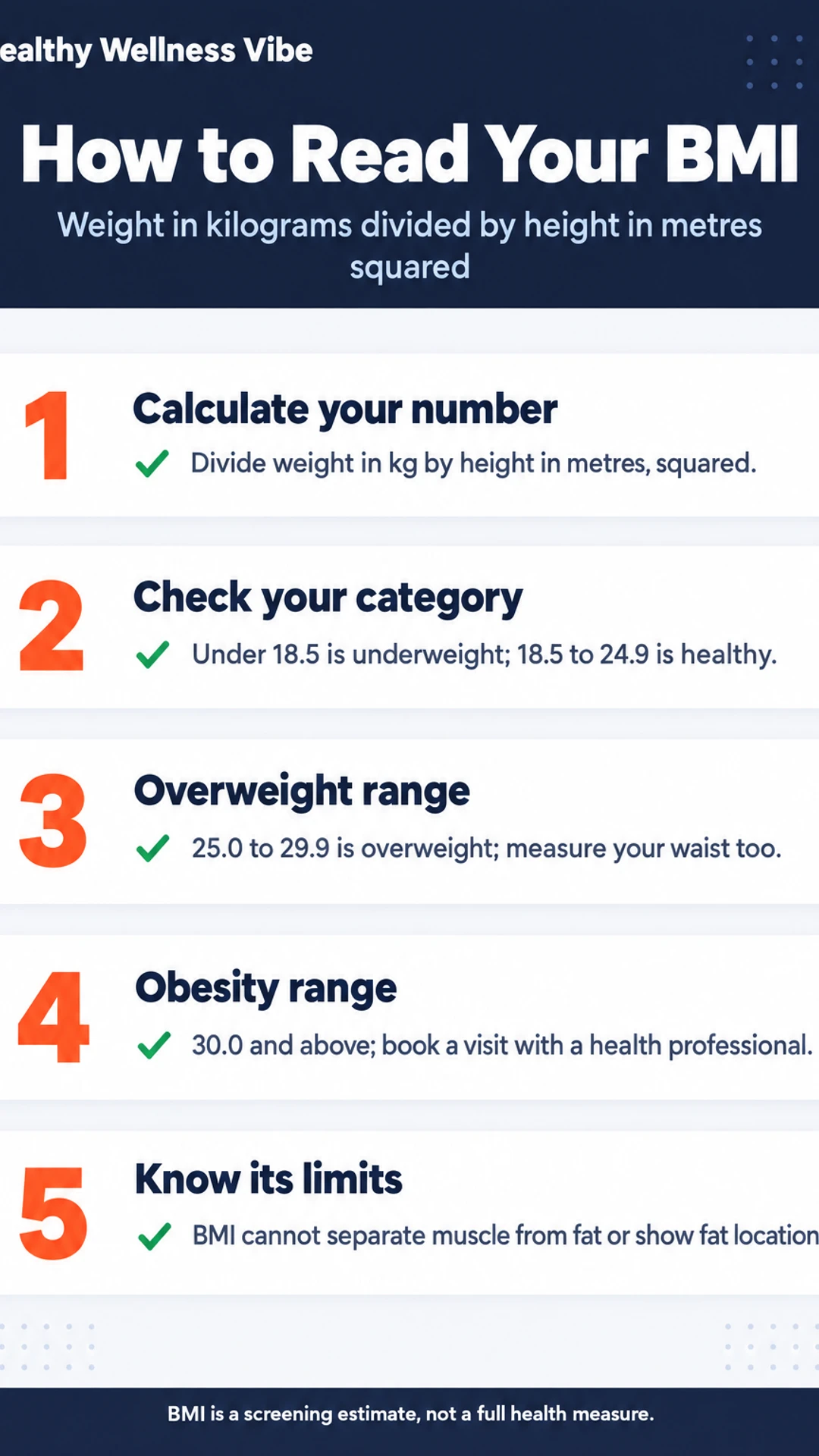
Body mass index (BMI) is your weight in kilograms divided by your height in metres squared. For adults 20 and older, a BMI of 18.5 to 24.9 is in the healthy weight range, below 18.5 is underweight, 25 to 29.9 is overweight, and 30 or above is in the obesity range. BMI is a screening estimate, not a full measure of health.
If you have ever typed your numbers into a calculator and stared at a single figure wondering what it actually means for you, you are not alone. Most of us have seen conflicting advice about weight, and it is easy to feel unsure whether a number on a screen says anything about your own body, your age, or your daily life. That uncertainty is frustrating, especially when you are already juggling study, work, and a kitchen that is not always well stocked.
This guide gives you a clear way forward. You will get a plain, step-by-step walkthrough for working out your BMI in minutes, with nothing more than a scale and a tape measure, and a straightforward way to read the category it places you in. You will also see where BMI falls short, so you know when to look at other measures.
Here is what the article covers:
- Calculating your BMI: the formula, with worked examples in metric and imperial units.
- Reading your category: what each range means for adults and where the cut-offs come from.
- Where BMI misleads: muscle, age, body frame, and why one number is never the whole picture.
- Practical next steps: simple habits to take from your result without crash diets or special equipment.
This guide is based on published specifications and what buyers report, not our own testing. Healthy Wellness Vibe's broader guide, Healthy Body: A Practical Guide to Eating Well and Building Daily Habits, covers the daily routines that support the numbers you are about to work out.
Walking Habit Progress Plan
What BMI Is and How to Calculate It
Body mass index, usually shortened to BMI, is a simple number that compares your weight to your height. It was designed as a quick screening tool for adults, not a complete picture of your health, but it is one of the most common ways doctors and public health bodies group people by weight. You can work it out yourself in a few minutes with a pen and a calculator.
What is the BMI formula?
In metric units, BMI is your weight in kilograms divided by your height in metres, squared:
BMI = weight (kg) ÷ height (m)²
If you use imperial units, the formula is:
BMI = (weight in pounds × 703) ÷ height in inches²
A worked example
Say you weigh 70 kg and are 1.75 m tall.
- Square your height: 1.75 × 1.75 = 3.0625
- Divide your weight by that number: 70 ÷ 3.0625 = 22.9
Your BMI is about 22.9.
Converting feet, inches and pounds
If you are in imperial units, start by turning your height into inches. One foot is 12 inches, so 5 feet 8 inches is (5 × 12) + 8 = 68 inches. Then square it: 68 × 68 = 4,624.
Next, multiply your weight in pounds by 703. For 160 pounds: 160 × 703 = 112,480.
Divide: 112,480 ÷ 4,624 = 24.3.
Round to one decimal place. Keep in mind that BMI is a guide, and a single reading is most useful when you compare it with a range, not a single cut-off.
Using a BMI Calculator in Minutes
A BMI calculator is one of the quickest health checks you can run at home, and it needs nothing more than a tape measure and a scale. Most standard calculators ask for the same few inputs, so it helps to have them ready before you start.
What the calculator asks for
- Age: BMI cut-offs are set for adults, so most calculators will not give a result for children or teenagers.
- Sex: some calculators use it to adjust the reading, since men and women typically carry body fat differently.
- Height: in centimetres or in feet and inches, stated clearly.
- Weight: in kilograms or pounds, again with the unit stated.
- Units: check the unit selector before you type anything.
Get a steady weight
Your weight can shift by a kilogram or more across a single day, depending on food, fluids and bowel contents. Weighing yourself in the morning, after using the toilet and before eating, gives you a number that is easier to compare over time.
Avoid the common input mistakes
- Swapping units, such as typing pounds into a field that expects kilograms.
- Entering feet as inches. A height of 5 feet 8 inches should be entered as 68 inches, not 5.8.
- Mixing metric and imperial values in the same calculation.
Check the result by hand
To verify the answer, divide your weight in kilograms by your height in metres squared. For example, 70 kg at 1.75 m gives 70 ÷ (1.75 × 1.75), which is about 22.9. A calculator result should match your hand check within rounding. If it does not, recheck your inputs first.
Reading Your BMI Category
Once you have your number, the next question is what it means. For adults aged 20 and older, the standard BMI categories are:
- Underweight: below 18.5
- Healthy weight: 18.5 to 24.9
- Overweight: 25.0 to 29.9
- Obesity: 30.0 and above
Treat the healthy range as a population guideline, not a personal target. It describes where most adults at a given height tend to sit with lower risk of certain conditions. It does not account for muscle, frame size, age, or how you feel, so a number just outside it is not a diagnosis.
What should I do next?
- Underweight: Talk to a clinician, especially if weight loss was unintended. They can check for causes and help you plan how to gain steadily.
- Healthy weight: Keep up the habits that got you here: regular movement, enough sleep, and mostly whole foods.
- Overweight: Measure your waist. A waist over about 40 inches (102 cm) for men or 35 inches (88 cm) for women points to higher risk, and it can be more useful than BMI alone. Small, steady changes to eating and activity are often enough to make a difference.
- Obesity: Book a visit with a health care professional. Ask about blood pressure, blood sugar, and cholesterol, since these help you find out what your weight may be affecting and what support fits you.
What about children and teens?
BMI categories are only for adults. For people under 20, clinicians use age- and sex-specific percentiles, which compare a child's BMI to others of the same age and sex. Use your pediatrician's chart for anyone younger than 20.
Adult BMI categories at a glance
| Category | BMI range | Suggested next step |
|---|---|---|
| Underweight | Below 18.5 | Talk to a clinician |
| Healthy weight | 18.5 to 24.9 | Keep current habits |
| Overweight | 25.0 to 29.9 | Measure waist, small changes |
| Obesity | 30.0 and above | Book a health care visit |
What BMI Does Not Tell You
BMI is a quick screening tool, not a verdict on your health. It uses only your height and weight, so it cannot see what that weight is made of. That is the first thing to keep in mind when you look at your result.
Can muscle make my BMI look high?
Yes. Muscle and bone are denser than fat, so a muscular person can have a BMI in the overweight range while carrying a healthy amount of body fat. If you lift weights, play sports, or do physical work, your number may overstate your risk. The reverse also applies: a high BMI does not automatically mean you have too much body fat.
Can I have a normal BMI and still carry too much fat?
Yes, and this is easy to miss. As people get older, they tend to lose muscle, and someone with less muscle can keep a normal BMI while their body fat rises. The same pattern appears in people who are not very active. Two people with the same BMI can have very different amounts of fat, so a normal result is not a guarantee.
What does my waist add?
Your waist measurement shows where fat sits. Fat stored around the middle is more closely linked to heart and blood sugar problems than fat on the hips or thighs. Measure around your waist, just above the hip bone, while relaxed. Pair that with your BMI to get a clearer picture.
What gives a fuller picture?
- Waist size, as described above
- Your fitness level, such as how far you can walk or how easily you climb stairs
- Blood markers like blood pressure, blood sugar, and cholesterol, which a health care provider can check
- Body composition measurements, when available
If you are concerned, a medical professional can help you interpret these together. BMI is a useful starting point, and it works best alongside the other information you have about yourself.
What BMI does and does not capture
| Measure | What it shows | Limitation |
|---|---|---|
| BMI | Weight relative to height | Cannot separate muscle from fat |
| Waist size | Where fat is stored | Needs careful, consistent measuring |
| Fitness level | How you handle daily activity | Not a number on its own |
| Blood markers | Blood pressure, sugar, cholesterol | Need a health care provider to check |
Answers to Common BMI Questions
Body mass index, or BMI, is a simple number calculated from your weight and height. It is a screening tool, not a diagnosis. Doctors use it as a starting point, then look at other measures such as waist size, blood pressure, blood sugar, and how you feel day to day. If you want to learn more about how the number is used in medical settings, national health agencies publish clear background information for adults.
Is a BMI of 23.4 healthy for a woman?
Yes, 23.4 falls within the standard healthy range of 18.5 to 24.9. That said, context still matters. Muscle mass, body fat distribution, age, and family history can all change what a number means for you. A woman with a BMI of 23.4 who is active and eats well is in a very different position from one who is inactive and has high blood pressure. Your health care provider can help you read the number alongside your other results.
Is a BMI of 20 too thin?
A BMI of 20 is within the healthy range, so it is not considered underweight. Still, the number alone does not tell the whole story. Pay attention to how you feel, whether your energy is steady, and whether you are eating enough to support your daily activity. If you are losing weight without trying or feel run down, talk with a medical professional.
What is a good BMI?
For most adults, the standard guideline is a BMI between 18.5 and 24.9. Below that range suggests underweight, 25 to 29.9 is classed as overweight, and 30 or above is classed as obesity. Higher BMI is linked with greater risk of conditions such as heart disease, high blood pressure, and diabetes, but the range is a guide, not a verdict on your health.
Next Steps After You Check Your BMI
Once you have your number, the useful question is what to do with it. A BMI result is a rough screening tool, not a verdict, and it does not tell you how much of your mass is muscle or body fat. It is a starting point for a conversation with yourself, or with a doctor if you have concerns about your health care needs.
Most people do better with small changes than with strict rules. Here are a few low-cost habits that work for many adults:
- Add a vegetable to one meal a day, such as a handful of frozen spinach in pasta sauce or a tin of beans in soup.
- Walk for 20 to 30 minutes most days, or take the stairs when you can.
- Drink water instead of sugary drinks at least some of the time.
Strict diets are hard to keep, especially on a busy schedule or a student budget. A habit you repeat every day will do more for you than a plan you abandon after a week.
How often should I check my progress?
Do not react to a single reading. Your weight can shift by a kilogram or more from day to day because of water, salt, and food in your system. Instead, weigh yourself once a week under similar conditions and look at the trend over several weeks.
If you want more practical ideas for eating and daily routines, the Healthy Body hub page covers them in more detail.
Frequently asked questions
What's a good BMI to have?
For most adults, a BMI from 18.5 to 24.9 falls in the range that the World Health Organization classifies as healthy weight. It is a screening range, not a personal target. Your doctor can tell you whether that range suits your height, build, age and health history, since muscle, frame size and body fat distribution all affect what a healthy number means for you.
Is BMI used by doctors?
Yes, doctors and health services use BMI routinely because it is quick, free and needs only height and weight. It helps flag when someone may be underweight, overweight or at higher risk. Most clinicians treat it as a starting point and then look at waist size, blood pressure, blood sugar, activity levels and how you feel before drawing conclusions.
Is a BMI of 23.4 considered healthy for a female?
Yes. A BMI of 23.4 sits inside the standard healthy range of 18.5 to 24.9, which applies to adult women and men alike. The formula does not adjust for sex, so the same cutoffs are used. Whether 23.4 is right for you specifically depends on factors like muscle mass, waist measurement and overall health markers.
Is 20 BMI too skinny?
A BMI of 20 is within the healthy range, so it is not classed as underweight. The underweight category starts below 18.5. Being in the lower part of the healthy range can still suit some people, but if you are losing weight unintentionally, feel tired often, or have stopped menstruating, speak to a doctor rather than relying on the number alone.
How do I calculate my BMI?
Divide your weight in kilograms by your height in metres squared. For example, 70 kg at 1.75 m gives 70 divided by 3.0625, which is about 22.9. In pounds and inches, multiply weight by 703, then divide by height in inches squared. Most online calculators do this automatically, but the manual method is simple enough to check any result yourself.
Wrapping up
BMI is a quick screening number, not a verdict on your health. A result between 18.5 and 24.9 is the standard healthy range for most adults. It says nothing about where your weight sits on your frame or how fit you are. If your number surprises you, bring it to a doctor and talk through what it means for you. Have you checked your BMI before? Share in the comments what the result told you.