Healthy BodyHealthy Body Fat Percentage: Ranges for Adults and How Measurement Changes the Number
Healthy Body Fat Percentage: Ranges for Adults and How Measurement Changes the Number
The short answer
For most healthy adults, a body fat percentage of roughly 10 to 20 percent is typical for men and 20 to 30 percent for women, with values rising slightly with age. These ranges are broad estimates. The number you get depends on the measurement method, hydration, and recent activity, so compare results only when they come from the same method under similar conditions.
- Typical ranges by sex and age: what the numbers look like for men and women across adult life.
- Why the same body can read differently: how the measurement method changes the result.
- Hydration and timing: how a big meal, a workout, or dehydration can shift a reading.
- Common measurement options: what each method involves and how far to trust it.
- How to track your own number: a simple way to watch the trend without buying equipment.
If you have ever looked up "what is a healthy body fat percentage" and come away more confused, you are not alone. One chart says 15 percent is fine, another says it is too high, and the scale at the gym gives a different answer than the tape measure at home. That mismatch makes it hard to know whether your number is something to worry about or something to ignore.
This guide gives you a clear starting point. You will see realistic ranges for adults, understand why readings vary so much, and learn how to measure in a way that lets you compare results over time. The aim is a number you can actually use, not a score that makes you anxious.
We will cover each point above in turn, so you can judge your own results with confidence. This guide is based on published specifications and what buyers report, not on our own testing.
What Counts as a Healthy Body Fat Percentage
If you want the short answer: for most adults, a healthy body fat percentage falls within a broad band rather than a single number. Commonly cited general ranges are roughly 10 to 20 percent for men and 18 to 28 percent for women, though these shift with age and fitness goals. Think of them as a range to aim within, not a pass or fail line.
Body fat is not all one thing. It splits into two broad types.
- Essential fat is the fat your body needs to function. It sits in the brain, nerves, bone marrow, and organs, and it is also what supports hormone production and temperature regulation. Women carry more essential fat than men, partly because of reproductive function.
- Storage fat is the extra fat that accumulates under the skin and around organs. It acts as an energy reserve. A moderate amount is normal, and it is not automatically harmful.
Very low body fat carries real health risks. When essential fat drops too far, people can experience hormonal disruption, poor recovery, and weakened bones. This is why extremely lean figures are not a target for general health, even among people who train hard.
Keep in mind that a body fat percentage is only one piece of the picture. Your age, sex, muscle mass, and overall fitness all matter, and a number that suits a competitive athlete may not suit you. Most people do better focusing on consistent eating, movement, and sleep rather than chasing a specific figure.
Healthy Body Fat Ranges by Age and Sex
When people ask what is a healthy body fat percentage, the honest answer is that there is a range rather than a single target. Body fat percentage is the share of your total body weight that comes from fat tissue, as opposed to muscle, bone, and water. The commonly cited general ranges for adults are below. Treat them as broad reference bands, not pass or fail marks.
Typical ranges for adult men (approximate):
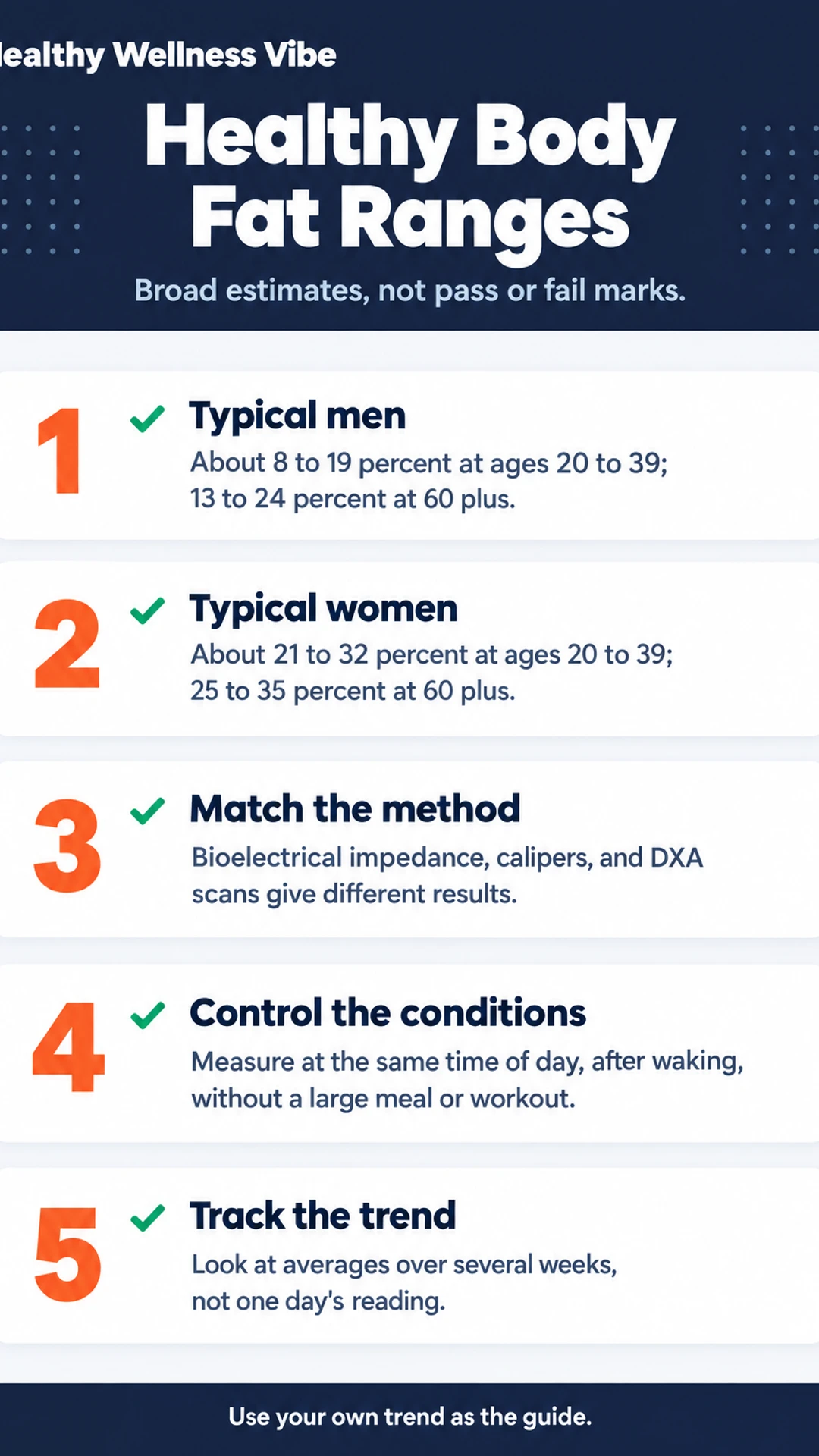
- Ages 20 to 39: about 8 to 19 percent
- Ages 40 to 59: about 11 to 21 percent
- Ages 60 and over: about 13 to 24 percent
Typical ranges for adult women (approximate):
- Ages 20 to 39: about 21 to 32 percent
- Ages 40 to 59: about 23 to 33 percent
- Ages 60 and over: about 25 to 35 percent
Body fat tends to rise modestly with age, partly because muscle mass often declines slowly if you are not doing regular resistance training. That means a number that sat in the middle of the range at 25 may sit a little higher at 50 without any change in how you feel or function. Interpret your result against your own age band, not a younger one.
Ranges overlap heavily, and a number near the edge is not automatically a problem. Sex, age, frame size, and how you measure all shift the result. A reading just above the upper limit deserves a look at your overall pattern: activity, sleep, and eating habits, rather than panic. Pair the number with other markers of your health for a fuller picture.
How Measurement Method Changes the Number
Before you compare your result to any range, check how it was measured. Two people with the same body can get different body fat percentage readings from two different tools, and that gap is often bigger than the change you are trying to track.
The most common option is bioelectrical impedance, the method used by many smart scales and handheld devices. These send a small electrical current through the body and estimate fat from how quickly it passes. The result is sensitive to hydration, meal timing, and recent exercise. A reading taken after a hard workout or a salty meal can shift by several percentage points, so take it at the same time of day, under the same conditions, each week.
Skinfold calipers are cheaper and need no electronics, but the result depends heavily on the person doing the measuring. You pinch the skin at set sites, and the chosen site and how firmly you pinch both matter. Use the same tester and the same spots if you want to track progress.
More precise lab methods exist, including DXA scans, hydrostatic (underwater) weighing, and the Bod Pod, which uses air displacement. These are usually costly and not routine, so most people will not use them. They are useful as a reference point when you need one.
When you compare numbers, match the method first. Use your own readings over time as the most useful source of data, and treat any single result as an estimate rather than a verdict.
Common body fat measurement methods
| Method | What it involves | Main limitation |
|---|---|---|
| Bioelectrical impedance | Small electrical current through the body | Shifts with hydration and recent exercise |
| Skinfold calipers | Pinching skin at set sites | Depends on who is measuring |
| DXA scan | Lab-based scan | Costly, not routine |
| Hydrostatic weighing | Underwater weighing | Not routine, needs specialist setup |
| Bod Pod | Air displacement | Costly, not routine |
Taking a Consistent Measurement at Home
Once you know the general ranges, the next question is how to get a reading you can trust. The honest answer is that a single number from one day tells you very little. What matters is whether you measure the same way each time, so that any change you see reflects your body rather than the conditions of the test.
Start by picking one method and sticking with it. Bioelectrical impedance scales, skinfold calipers, and tape measures all give different results, and switching between them will make your numbers look like they are jumping around when they are not. A bathroom scale with impedance is the easiest option for most people, and it is fine for tracking trends as long as you keep using the same device.
Here is a simple routine to follow:
- Measure at the same time of day, ideally in the morning after you wake up and use the toilet.
- Measure in the same conditions each time, wearing similar clothing or none at all.
- Avoid measuring straight after a workout, a large meal, or alcohol, since these shift your hydration and water balance.
- Avoid measuring when you are dehydrated, for example after a hot day or a stomach bug.
- Record each reading in a notes app or spreadsheet with the date.
How often should you check, and what should you look for?
Weigh your results over several weeks rather than reacting to any single reading. Daily fluctuations of a percentage point or more are common and usually reflect water, not fat. Look at the average across a few weeks, and only then decide whether the direction is moving the way you want. Patterns over time are far more useful than any one number.
Reading Your Result Alongside Other Signals
A single body fat percentage is one piece of information, and it is rarely the most useful one on its own. Your result is most helpful when you read it next to a few other signals that are easy to check at home.
The body mass index is the number most people already know, and it is quick to calculate. It divides body weight by height squared, and the body mass index categories are a useful first screen for the general population. Its main limitation is that it cannot tell muscle from fat. Someone who trains regularly and carries a good deal of muscle mass can land in the "overweight" band while having a lean, healthy body. If your body mass index looks high but you are strong and fit, do not assume the number is the full story.
A waist measurement is a simple companion check that needs only a flexible tape. Measure around your waist at the level of your navel, relaxed, after breathing out. Keep the tape level and snug, not squeezing. Waist size reflects how much fat sits around your middle, which is linked to health risk, and it does not require any calculation.
Pay attention to how you actually feel and function. Ask yourself:
- Do I have steady energy through the afternoon?
- Am I sleeping through most nights and waking up rested?
- Can I climb stairs, carry shopping, or keep up with training without unusual fatigue?
- Is my strength improving over weeks, not just my number on the scale?
If the answers are mostly yes, your body is working well, whatever a single figure says. If they are consistently no, that is worth discussing with a doctor, regardless of your result.
When to Get Advice and How to Work Toward a Healthier Range
A body fat number is only one piece of the picture, and a single reading taken on a home device should not be treated as a diagnosis. Some situations are worth a conversation with a doctor or registered dietitian rather than another round of self-testing. Consider booking an appointment if you notice:
- Unexplained weight change, gaining or losing several kilograms without a clear reason over a few weeks
- Very low readings alongside tiredness, dizziness, missed periods, or feeling cold all the time
- Persistent swelling, unusual thirst, or changes in appetite that you cannot account for
- Concerns about eating, or a strong urge to restrict food to hit a number
For most people, progress comes from small habits repeated daily rather than from a strict plan. You do not need special equipment or an expensive program to start:
- Eat regular, balanced meals built around vegetables, a protein source, and a whole grain or starchy food.
- Walk for 20 to 30 minutes most days, and add a few more minutes when you can.
- Aim for a consistent sleep schedule, since short or irregular sleep makes hunger and cravings harder to manage.
- Do simple bodyweight resistance work two or three times a week, such as squats, push-ups against a wall, and bridges. This helps you keep muscle while you change body composition.
Set goals that are slow and realistic, often around half a kilogram to a kilogram a week if you are aiming to lose. Chasing very low numbers rarely lasts and can work against your health. Rather than fixating on one result, track how you feel, how your clothes fit, and how your strength improves over time.
Frequently asked questions
Is 20% body fat skinny?
Not necessarily. For most adult men, 20% body fat falls within a commonly cited healthy range, and for many adult women it is on the lean side of average. Whether it looks skinny depends on where the fat sits, muscle mass, height, and frame size, so the number alone does not settle it.
What should my body fat percentage be for my age?
Typical healthy ranges rise slightly with age, because body fat tends to increase gradually as people get older. Adult men are often in the low-to-mid teens up to about 20% and women roughly in the high teens to upper 20s. Measurement method changes the result, so compare readings from the same method over time.
Is 30% body fat chubby?
For most adult men, 30% body fat is above the usual healthy range, and for many adult women it sits at the upper end of typical ranges. It is not a diagnosis by itself. A doctor looks at overall health markers, fitness, and waist measurement alongside the percentage.
Is 12% body fat skinny?
For most adult men, 12% is lean and sits near the bottom of common healthy ranges, often seen in people who train seriously. For most adult women, 12% is very low and can be linked to hormonal and health problems. Being this lean is not automatically healthy for everyone, so context matters.
How accurate is a body fat scale or calipers?
Home bioelectrical impedance scales and skinfold calipers give estimates, not exact values. Hydration, time of day, and how recently you exercised can shift a reading by several percentage points. DXA scans are more precise but cost more. For tracking, pick one method, test under the same conditions, and watch the trend rather than single readings.
Wrapping up
A healthy body fat percentage is a range, not a single target, and it shifts with sex, age, and how the number was measured. A reading from a home scale and one from a DXA scan can differ by several points, so compare like with like. In my own view, the trend across weeks tells you more than any one figure. What method have you used to measure your body fat, and did the number surprise you? Tell me in the comments.